

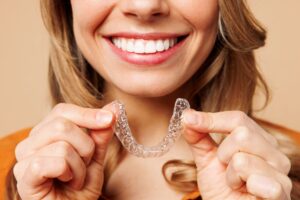
You’re not alone if you’re eager to straighten your smile but prefer to avoid the frustration and feelings of self-consciousness often associated with traditional orthodontics. Thankfully, many dentists offer Invisalign, a more discreet and comfortable alternative.
But if you already have existing restorations, such as veneers, dental crowns, or implants, you might wonder if you can successfully complete this treatment. Continue reading to learn more about it so you know what to expect!
How Does Invisalign Work?
Unlike standard braces, which use metallic brackets and wires, Invisalign relies on a series of transparent plastic trays to shift your teeth to their ideal places or correct a mild to moderate bite misalignment. These clear trays are customized to fit snugly over your arches, and must be worn 20 to 22 hours daily to prevent potential relapse.
Then, after about a week or two, you’ll be directed to switch to the next pair to stay on track with your treatment plan. Many patients complete this service within 12 to 18 months, though it can sometimes take longer for those with pre-existing dental work.
Can I Get Invisalign if I Have a Restoration?
You’re not alone if you’re worried that these clear aligners might not be strong enough to effectively shift restored teeth. Continue reading to learn more about whether veneers, crowns, and implants could affect treatment with these transparent trays.
Invisalign with Veneers
Veneers are thin, ceramic shells that are customized to resemble your enamel, then are cemented to the fronts of your teeth to mask aesthetic concerns. Technically, it’s possible to get Invisalign with these covers in place, as long as your dentist ensures a proper fit.
However, if too much pressure is applied to your veneers, they may be damaged or pushed out of place. As a result, clear trays might be recommended only to address minor misalignments.
Invisalign with Dental Crowns
Dental crowns are customized, tooth-shaped caps that are cemented over injured or decayed teeth to restore their function and appearance. As with veneers, it may be possible to successfully complete Invisalign as long as your restoration is firmly cemented in place and your trays are carefully customized to accommodate its dimensions.
Invisalign with Dental Implants
These replacement teeth are the only ones that involve placing a support rod directly into your jaw, which eventually fuses with the bone to become a more permanent part of your mouth. This allows them to function more like natural teeth, though they’re not connected to your arches with the same muscles and ligaments, and therefore don’t have the same capacity for movement.
As a result, your dentist may be able to shift the teeth surrounding your implant, but not the prosthetic itself.
If you’re still unsure whether you’re a good candidate for Invisalign, you can find out by consulting your provider!
About the Practice
At Flenniken Family Dentistry, patients of all ages benefit from a team of dentists who are passionate about helping them build and maintain their happiest, healthiest smiles. They share decades of combined experience, and today, they collaborate to offer a complete menu of services, including Invisalign, to meet your unique needs under one roof. Their compassionate approach is paired with advanced technology to deliver more accurate and comfortable treatment results intended to last. You can request an appointment on the website or call (717) 249-7777.